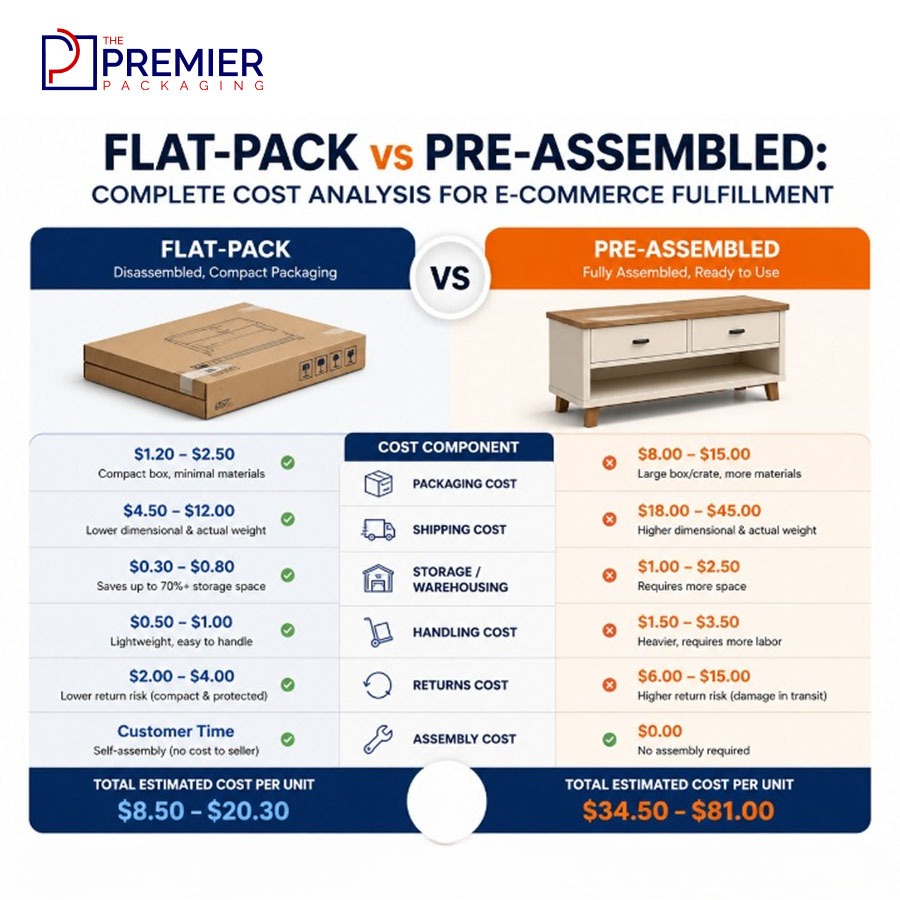
Each e-commerce fulfillment choice directly affects the profit.
The choice of packaging is one of the most important decisions that can impact shipping costs, warehouse efficiencies, labor costs, and customer satisfaction. Most brands make this decision without systematically considering the financial aspects, opting for traditional methods.
Put flatpack and pre-assembled containers under the microscope, and the cost picture is a world apart. Knowing these differences helps to determine which one is most profitable for certain business models.
This comprehensive cost analysis will help guide decisions for fulfillment packaging strategy.
Recognize the Two Approaches.
The pre-assembled containers are ready to be packed without any assembly required before products are packed.
They are stored in their final shape in these containers. They come pre-prepared! There’s no assembly at fulfillment centers. Staff fill, seal and ship.
Flat-pack containers are shipped in a compressed state that needs to be quickly packed for shipping.
Intuitive mechanisms ensure containers assemble in just seconds. All assembly is done “just in time” when orders are being packed. This method involves embedding the assembly within the natural fulfilment processes.
Shipping Cost Comparison
The biggest cost difference between the approaches is shipping.
Pre-Assembled Shipping Analysis Dimensional specifications: 10″ x 8″ x 6″ = 480 cubic inches Dimensional weight: 480 ÷ 166 = 2.89 lbs Actual container weight: 0.35 lbs Charging weight: 2.89 lbs (dimensional weight) Plus product weight: 2.0 lbs Total charge weight: 4.89 lbs per package
Product weight vary between 2.0 and 2.2 lbs per product.Product weight range of 2.0-2.2 lbs per product.
Weight reduction: 4.89 – 2.18 = 2.71 lbs (55% reduction) Cost reduction per package: 2.71 lbs × $0.80 per lb = $2.17 per package
For 10,000 monthly shipments: Monthly shipping savings: 10,000 × $2.17 = $21,700 Annual shipping savings: $260,400
The impact on the warehouse and storage.
The second cost differential is storage efficiency.
Pre-Assembled Storage Requirements: Container dimensions: 10” x 8” x 6” = 480 cu. in. per container, Containers per pallet: 500, Pallets per warehouse section: 40, Units per section: 20,000, Space per section: 400 sq. ft.
The container sizes are 10″X8″ X0.5″ = 40 cu. in. per container, and the containers are packed 5,000 per pallet, 4 pallets per warehouse section and 20,000 containers per warehouse section (same inventory). There are 50 sq. ft. per section.
The reduction in space is 87.5% for 350 square feet per 20,000 units.
Analysis of storage costs at $15 per month per square foot: Monthly costs: Pre-assembled: $15 x 400 sq ft = $6,000 Flat-pack: $15 x 50 sq ft = $750 Monthly savings: $6300 x 12 months = $63,000
The cost of labor and assembly.
Careful analysis is required to consider labor for assembly and eliminate pre-assembly.
The total labor required to assemble the models is: 2 hours pre-Assembled/day x 40 hours/day for laborers + 4 hours/day x 80 hours/month for the organization laborers + 0, already retrieved hours/day x 40 hours/day for laborers = 120 hours/day x $18/hour x 40 hours/month = $2,160 monthly
The total flat-pack labor is 103 hours monthly (0.5 hours daily + 83 hours daily during fulfillment), and the net flat-pack labor cost is $1,854 monthly ($3,672 annual, $306 savings monthly).
This is a box that is used for performance in reverse, also known as the Reverse Tuck End Box.
Reverse tuck-end boxes are examples of the best flat-pack design.
- Design Efficiency Quick assembly mechanism:
- 3-5 seconds per container No tape or external securing required
- Reduces material costs Integrated cushioning capability:
- Reduces padding expenses Optimized dimensions:
- Minimizes dimensional weight
Engineered simplicity is the key to making reverse tuck-end boxes better than traditional options. No external material used for secure containment with tuck closure. Assembling the device is faster than other flat-pack options.
Fill out the Annual Cost comparison form.
All cost factors, consolidated, provide a complete financial picture.
Pre-Assembled Annual Costs (10,000 monthly shipments) Shipping Costs: $122,000 Warehouse Storage Costs: $72,000 Receiving and Handling Labor Costs: $25,920 Total annual cost: $219,920
Yearly Costs Flat Pack cost $109,400 Shipping cost (including assembly efficiency gain): $109,400 Warehouse storage cost: $9,000 Receiving and handling Labor cost: $22,248 Assembly Labor cost: $9,960 Total annual cost: $150,608
Annual cost difference: $219,920 – $150,608 = $69,312 Savings percentage: 31.5%
You will be dealt with the Hidden Costs and Additional Considerations.
There are a number of factors beyond the direct costs that will affect the financial impact.
Damage cost reduction: $5,000-$10,000 per annum Customer satisfaction improvement results in reduced returns Damage reduction: 20-30% Damage rates Reduction
Heavier duty shelving and racking is required for Infrastructure Investment Pre-assembled, while a minimal storage infrastructure is required for Infrastructure Flat-pack, with the cost difference between the two being $30,000-$50,000 one-time.
Quality Perception Reverse tuck end boxes communicate quality through smart design Premium perception justifies higher product pricing Price improvement potential: 5-10% margin increase
Operational Efficiency Gains
Aside from the cost saving, the flat-pack solutions are also more efficient in operation.
Space efficiency: Speed of fulfillment increase by 15-25% Customer satisfaction: More and more, same-day shipping becomes possible.
Rapid product line expansion; Flexibility Benefits Flat-pack allows for the expansion of the product line without the need of increasing warehouse sizes; Seasonal volume ups accommodate much better.
Reduce returns and complaints, improve accuracy, faster fulfillment, better organization from space efficiency, reduce error rates, quality control
Decision Framework
This framework should be used to assess the situation of brands.
Use Pre-Assembled for low volume (less than 2,000 shipments) or space constraints or premium-priced items where labor availability is more than needed for fulfillment
If Volume > 2,000 monthly shipments, Warehouse space is costly or limited, Labor costs are high, or Shipping is a big expense category, you would want to consider Flat Pack.
If you are expecting an increased volume of over 2,000 monthly shipments, have limited warehouse space, have a high labor cost or shipping is a major expense category, you may want to consider Flat Pack.
Real Implementation Example
A beauty company that shipped 15000 boxes per month ordered reverse tuck-end boxes.
Our least expensive solution for 2020 is currently $225,912 per year.Our lowest-cost solution for 2020 is $225,912/year, with a payback in 2 months.
The brand invested its savings back into marketing to take market share from competitors relying on traditional packaging. Over time, competitive advantage based on cost efficiency.
Bottom Line
A thorough cost analysis shows that for most e-commerce businesses, flat-pack solutions offer a 30-40% cost saving. These savings are achieved through engineering excellence – weight reduction, space efficiency, and labor optimization in reverse tuck-end boxes.
These benefits are not just monetary they also include competitive positioning, customer satisfaction, and scalability. Flat-pack fulfillment strategy is becoming increasingly crucial for many growing e-commerce brands.